
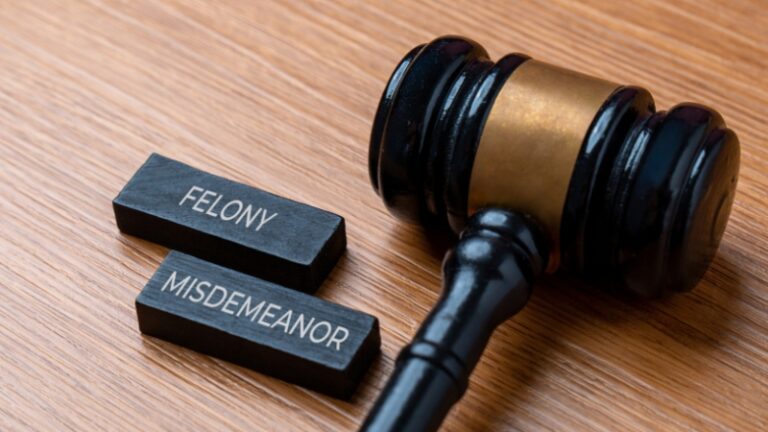
A felony and a misdemeanor are not just two labels for “crime.” They are two very different legal lanes, and the difference can shape nearly every part of a person’s future.
In the simplest terms, a felony is the more serious category and is usually tied to crimes punishable by more than one year in prison, while a misdemeanor is the lower category and usually carries a maximum sentence of up to one year, often served in a local jail rather than a prison.
But the real gap is bigger than jail time. A felony conviction is far more likely to trigger long-term damage to voting rights, firearm rights, immigration status, licensing, housing, and employment.
A misdemeanor can still disrupt a life badly, especially if it involves violence, theft, DUI, or repeated conduct, but a felony usually changes the legal and practical rules around you in a much harsher way.
The Basic Legal Difference

Under federal law, crimes are classified largely by the maximum punishment authorized. The federal classification statute places offenses punishable by more than one year in prison in the felony category, while offenses with a maximum term of one year or less are misdemeanors.
Federal law then breaks felonies into Classes A through E and misdemeanors into Classes A through C, depending on the authorized maximum sentence. That framework is useful because many states use a similar idea even though the exact names, sentencing ranges, and offense lists vary by jurisdiction.
So when people ask, “Is a felony always more serious than a misdemeanor?” the answer is generally yes, but the details still depend on the state, the charge, and sometimes the defendant’s prior record.
A lot of readers assume the label by itself tells the whole story. It does not. Two charges that sound similar can land in different categories depending on the facts. Shoplifting a low dollar amount may be charged as a misdemeanor in one case, while a higher amount, repeat offense, or organized theft theory can push it into felony territory.
The same pattern shows up with assault, drug possession, property damage, fraud, and DUI. Injury level, weapon use, prior convictions, dollar value, and even who the alleged victim is can all upgrade a case.
That is why people sometimes say one “mistake” changed everything. Often the life-changing part is not the conduct alone, but the way the law classifies it.
Why the Label Matters so Much
View this post on Instagram
The public often treats misdemeanors as minor and felonies as major, but the legal system uses those labels to decide far more than sentence length. A felony conviction can open the door to prison, longer probation or supervised release, larger fines, harsher collateral penalties, and tighter restrictions after the sentence ends.
A misdemeanor can still mean jail, probation, court costs, classes, monitoring, restitution, or a permanent record, but the long tail of punishment is usually less severe. That “long tail” is what many people underestimate. The case may end, but the record keeps working against them.
This is especially important because criminal punishment in the United States is not limited to what the judge says in court. The Council of State Governments’ collateral consequences inventory documents tens of thousands of legal and regulatory restrictions tied to criminal records across the country.
Those consequences can affect occupational licenses, government benefits, education, jury service, housing, and business opportunities. In other words, the sentence on paper may be six months, one year, or probation, but the real-world sentence can run much longer.
Quick Comparison Table
Issue
Misdemeanor
Felony
Usual legal seriousness
Lower-level offense
Higher-level offense
Typical maximum custody
Up to 1 year
More than 1 year
Typical place of confinement
Local jail
State or federal prison
Long-term record impact
Can be serious
Usually much more severe
Voting consequences
Varies, often limited or none
More likely to trigger loss or suspension depending on state
Firearm consequences
Sometimes, depending on offense
Often major under federal law for crimes punishable by more than 1 year
Immigration risk
Can still be severe for some offenses
Often much higher, especially for aggravated felony-type outcomes
Employment and licensing barriers
Common
Usually broader and more stubborn
Federal classifications and major collateral consequences support this overall pattern, though every state has exceptions.
A Misdemeanor Can Still Wreck Your Life

Calling a misdemeanor “minor” is one of the most misleading habits in legal talk. Many misdemeanors still carry jail exposure, mandatory court appearances, fines, ignition interlock requirements, probation conditions, counseling, no-contact orders, community service, and a record that appears in background checks.
For a working adult, that can mean missed shifts, lost income, suspended driving privileges, child-care problems, and a harder time renting an apartment or keeping a professional license.
The Equal Employment Opportunity Commission has long warned employers that conviction-record screening raises civil-rights concerns and that arrest alone is not proof of criminal conduct, but in practice, a record can still narrow opportunities fast.
Misdemeanors can also carry hidden severity because certain offense types matter more than the label. A misdemeanor domestic violence conviction, for example, can create firearm restrictions under federal law. A misdemeanor theft offense can damage trust-based job prospects.
A misdemeanor DUI can affect insurance, driving, travel, and employment. A misdemeanor involving moral turpitude or a controlled substance can create immigration trouble even when the person never served serious jail time.
So while felonies usually bring the heavier long-term burden, some misdemeanors punch far above what the word “misdemeanor” suggests.
Why a Felony Is Usually the True Dividing Line
A felony is often the point where society stops treating the conduct as a bad episode and starts treating the person as a long-term risk category. That shift shows up everywhere. Under federal firearms law, people convicted of crimes punishable by more than one year generally fall into prohibited-person status.
State voting-rights rules also change sharply at the felony line, though restoration rules vary widely. Some states restore rights after release or sentence completion, while others require extra steps, and a few have historically imposed far stricter rules.
For noncitizens, the felony line can be even more dangerous, although immigration law does not always track state criminal labels perfectly. Some convictions can be treated as crimes involving moral turpitude or as aggravated felonies for immigration purposes, depending on the offense elements and sentence.
In practice, that means a plea deal that looks manageable in criminal court can still trigger deportation risks or block future immigration relief. This is one reason criminal defense lawyers are expected to consider immigration consequences when advising some clients.
How One Charge Can Become the Turning Point
Here is where readers connect with the subject emotionally, because this is what happens in real life. A college student gets into a fight, someone is injured, and a simple battery allegation becomes aggravated assault because of the injury or object used.
A person with a substance-use problem is caught repeatedly and a possession pattern turns into a higher-level charge. A worker under financial stress alters invoices or takes merchandise, and the dollar amount crosses a felony threshold.
A driver makes a reckless decision, causes injury, and what looked like “just a bad night” becomes a felony DUI case. The life change often comes from aggravating details: injury, value, repeat behavior, weapons, protected victims, or probation status.
That is also why two people can describe their case as “basically the same” and still end up in very different places. One gets a misdemeanor and probation. The other gets a felony, prison exposure, and a record that follows them for years.
The criminal code not only punishes acts. It grades them. And once a case moves into felony territory, the consequences compound faster.
Real-World Consequences Beyond the Courtroom
Area of life
What often happens after a misdemeanor
What often happens after a felony
Jobs
Employer concern, especially for recent or job-related offenses
Broader exclusion, especially for licensed, financial, security, or public-facing roles
Housing
Screening problems possible
Denials more likely, especially with serious or recent convictions
Professional licenses
May trigger disclosure and review
More likely to trigger denial, delay, or discipline
Civil rights
Usually fewer broad automatic losses
Voting and firearm rights more likely to be restricted
Immigration
Risk depends heavily on offense type
Risk often much greater, sometimes catastrophic
Reputation
Serious local and personal fallout
More durable stigma and background-check damage
Housing and employment are especially important because they shape whether someone can stabilize after a case.
HUD guidance has emphasized that blanket or overbroad criminal-record policies can raise Fair Housing Act concerns, particularly where they rely too heavily on arrest records or are not closely tied to legitimate safety goals.
Employment law has a similar pattern: not every record can lawfully justify exclusion, but records still matter in the marketplace, and felonies tend to hit hardest.
The System Is More Misdemeanor-Heavy than Many People Think

One overlooked fact is that the criminal system runs on huge volumes of misdemeanor cases. Legal scholarship and court research have repeatedly noted that misdemeanors make up the large majority of criminal filings in the United States.
That matters because it means millions of people encounter the justice system through offenses that are officially “less serious” but still powerful enough to cost money, freedom, housing stability, and employment. The front door of the criminal system is often a misdemeanor court, not a dramatic felony trial.
That helps explain a strange truth: misdemeanors are more common, but felonies are more life-defining. A misdemeanor can drag someone into the system; a felony is more likely to brand them within it.
Both matter. One is simply more likely to alter the rest of the person’s civic, economic, and legal life.
Can a Record Ever Be Cleared?
Sometimes, but never assume it is automatic. Expungement, sealing, diversion, deferred adjudication, reduction, and restoration rules vary sharply by state. In some places, many misdemeanors are easier to seal or expunge than felonies.
In others, some low-level felonies can eventually be reduced or sealed, while violent offenses remain largely excluded. The important point is that the difference between a misdemeanor and a felony often affects not only the initial punishment but also how hard it will be to clean up the record later.
Bottom Line
@jdegasperis_esq What’s the difference between a felony and a misdemeanor? #Personalinjury #lawyer #attorney #caraccident #law #personalinjurylawyer #lawfirm #accident #legal #lawyers #justice #lawyerlife #personalinjuryattorney #lawyersoftiktok #injury #attorneys #slipandfall #litigation #autoaccident #attorneyatlaw #car #insurance #carcrash #criminaldefense #lawschool #attorneylife #lawsuit #personalinjurylaw #newyork #newyorklawyer ♬ original sound – John A. DeGasperis – Attorney
The real difference between a felony and a misdemeanor is not just that one is “worse.” It is that the misdemeanor usually punishes the event, while the felony is more likely to reshape the future.
A misdemeanor can still cost someone their job, money, license, housing opportunity, or immigration safety. But a felony is far more likely to trigger the kind of legal and social barriers that continue long after probation, jail, or prison ends.
That is why one mistake can change your life. Not because every defendant becomes permanently trapped, and not because every misdemeanor is small or every felony is beyond recovery, but because the criminal label attached to a case changes how the law, employers, landlords, licensing boards, and government systems treat you afterward.
In criminal court, classification is not paperwork. It is destiny-shaped by statute.