
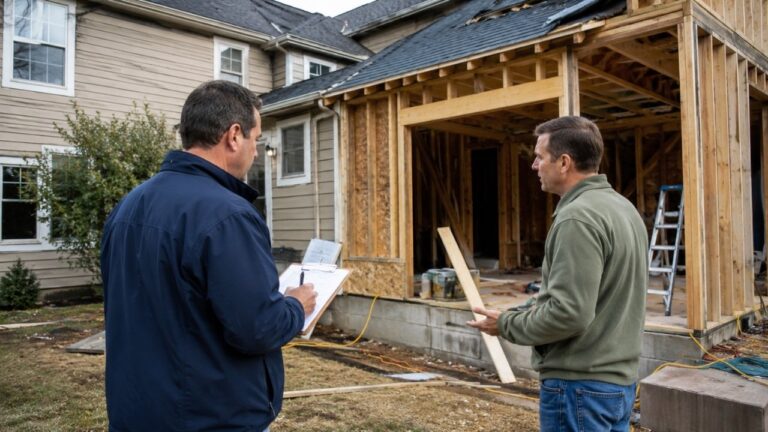
The Harvard Joint Center for Housing Studies puts annual home improvement and repair spending above $600 billion across the country’s 145 million homes, roughly 50 percent higher than before the pandemic. Only a share of that work ever crosses a permit counter.
No federal agency tracks how many projects skip the paperwork, and that gap is the whole story. Permits are enforced by cities and counties rather than by Washington, so the penalty for building without a permit in Seattle looks nothing like the penalty in Miami or Houston.
What stays consistent is the sequence. A neighbor complains, or an appraiser notices a room that does not appear on record, and a stop work order follows. Building without a permit almost never gets discovered on the owner’s schedule.
Key points:
- Enforcement happens locally, so what you pay depends on your city or county rather than on any national rule.
- Most penalties combine a stop work order, a retroactive permit at an inflated fee, and a daily fine.
- New York City ties its civil penalty to the permit fee, which is why the bill grows fast on larger projects.
- Nearly all unpermitted work can still be legalized through an after the fact permit and an inspection.
- Building without a permit appears as a criminal misdemeanor in several state statutes, not just as paperwork.
- Denied insurance claims and stalled home sales usually cost more than the original fine ever did.
What Happens the Moment the City Finds Out

Enforcement rarely starts with a knock on the door. It starts with a neighbor’s complaint, an inspection next door, or an adjuster asking questions after a claim. Once the file opens, building without a permit moves through a predictable order of steps.
The stop work order comes first
Before anyone calculates a fine, the department orders the work to stop. For example, Seattle states this plainly: the city may issue a stop work order for building without a permit, and it may fine you or take further action.
The policy sits on the Seattle Department of Construction and Inspections page. The order also means concealed work has to be opened up, and that reversal usually costs more than the penalty itself.
When it stops being a fee and becomes a charge
Most homeowners assume the worst case is a large invoice. Some statutes go further. California Health and Safety Code section 17995 makes a violation of the State Housing Law a misdemeanor punishable by up to one thousand dollars, six months in jail, or both, and section 17995.1 raises that to five thousand for a repeat at the same property within five years.
Charges like this are uncommon, but the difference between a felony and a misdemeanor affects background checks and licensing for years.
The Extremes, From an Investigation Fee to a Demolition Order
The gap between the mildest and harshest outcomes for building without a permit is wide enough that national averages mean very little.
The expensive end
New York City sits at the top.
The Department of Buildings sets the civil penalty on a one or two family dwelling at six times the permit fee, with a six hundred dollar minimum and a ten thousand dollar cap.
For other building types the multiplier climbs to twenty one, and a second violation within a year gets doubled.
At the far end sits removal. When a structure cannot be brought into compliance, the order is demolition at the owner’s expense.
The manageable end
Seattle caps daily exposure at five hundred dollars. Massachusetts municipalities work from a state code allowing up to one thousand dollars per day plus a doubled permit fee.
Either way, the file closes once the department has a complete application, which means a measured site plan showing the structure, setbacks, and property lines.
Owners in this spot often use a drafting service like Get A Site Plan rather than redrawing the lot from memory.
Penalties in the 25 Largest US Cities
More than nineteen thousand municipalities each write their own fee schedule, so covering every jurisdiction is impossible. The table below takes the twenty five largest cities by Census Bureau estimates for July 2025.
Where a department publishes a number for building without a permit, it appears. Where the amount is set case by case, the entry says so rather than inventing a figure.
| City | Penalty for unpermitted work | Official department |
|---|---|---|
| New York, NY | Six times the permit fee, $600 minimum, $10,000 cap on one and two family homes, doubled on a repeat | NYC Buildings |
| Los Angeles, CA | State misdemeanor exposure up to $1,000, plus city investigation fees | LADBS |
| Chicago, IL | Daily fines plus retroactive permit fees | Chicago Buildings |
| Houston, TX | Retroactive permit required, fees set by ordinance | Houston Permitting Center |
| Phoenix, AZ | Investigation fee added to the permit fee | Planning and Development |
| Philadelphia, PA | Violation notice with daily fines until the permit issues | Licenses and Inspections |
| San Antonio, TX | Stop work order and permit at an increased fee | Development Services |
| San Diego, CA | State misdemeanor exposure plus city investigation fees | Development Services |
| Dallas, TX | Stop work order, injunction available under state law | Building Inspection |
| Fort Worth, TX | Citation plus after the fact permit | Development Services |
| Jacksonville, FL | Fines set by the local code enforcement board | Planning and Development |
| Austin, TX | Stop work order plus added review fees | Austin Development Services |
| San Jose, CA | State exposure plus city penalty fees on late permits | Planning and Code Enforcement |
| Charlotte, NC | Handled by the county on a county fee schedule | Mecklenburg County Code Enforcement |
| Columbus, OH | Violation notice plus retroactive permit | Building and Zoning Services |
| Indianapolis, IN | Citation plus after the fact permit | Business and Neighborhood Services |
| San Francisco, CA | Penalty fee on permits pulled after work has begun | Department of Building Inspection |
| Seattle, WA | Up to $500 per day | SDCI Permits |
| Denver, CO | Investigation fee plus corrective permit | Community Planning and Development |
| Nashville, TN | Codes violation, retroactive permit and inspection required | Metro Codes |
| Oklahoma City, OK | Citation plus after the fact permit | Development Services |
| Washington, DC | Stop work order plus civil infraction fines | Department of Buildings |
| El Paso, TX | Retroactive permit with added fees | Planning and Inspections |
| Las Vegas, NV | Investigation fee plus permit fee, county rules apply outside city limits | Clark County Building and Fire Prevention |
| Boston, MA | Up to $1,000 per day under state code, plus a doubled permit fee | Massachusetts building permits |
If your city is not listed, your state code agency will point you to the right local office:
- Florida Statutes 553.79
- Oregon Building Codes Division
- North Carolina Office of State Fire Marshal
- Minnesota Department of Labor and Industry
How to Legalize Unpermitted Work After the Fact
Almost everything is fixable. Building without a permit becomes permanent only when an owner ignores the notice long enough for the case to turn into court action or a lien.
The basic path
Departments follow roughly the same process, and coming forward voluntarily usually costs less than waiting to be caught.
- Call the department, describe the work honestly, and ask what an after the fact permit requires.
- Prepare a site plan and floor plan showing what was built, with dimensions and setbacks.
- Submit the application and pay the permit fee plus whatever penalty multiplier applies locally.
- Open concealed framing, wiring, or plumbing so an inspector can verify it.
- Correct what fails, request a final inspection, and keep the closed permit with your records.
Amnesty and code relief windows
Some jurisdictions run programs built for older work. Miami-Dade County publishes a code relief process for exactly this. New York City handles legalization of unpermitted residential conversions through its own filing system, explained in the DOB NOW Build FAQs.
If a contractor took your money and never pulled the permit, that is a separate fight. Depending on the amount it may belong in small claims court, or be worth weighing mediation against a full trial.
The Costs That Show Up Years Later
The fine is rarely the expensive part of building without a permit. Insurers write policies assuming the structure met code when it went up, so a denied claim after a fire or a burst pipe can dwarf any city penalty.
Resale is the other pressure point. Appraisers count permitted square footage, so an unpermitted addition often adds nothing to the valuation, and buyers routinely ask the seller to resolve it before closing. Landlords carry extra exposure, since habitability disputes and mold claims surface exactly the kind of hidden work that never passed inspection.
What people ask
Final Verdict
There is no tidy national number, and any article offering one is guessing. Building without a permit costs anywhere from a few hundred dollars to a demolition order, depending on which department covers your address and how long the violation sat unaddressed.
Departments treat voluntary disclosure far better than discovery, penalties compound with time, and the paperwork you fix this year is the insurance claim you do not lose five years from now.